Looking at the evolution of computer programming—from binary switches to assembly, high-level languages, and now natural language—the trend of technical democratization and lowering the barrier to entry has remained consistent. However, observing just the past two years, the way we code is undergoing a fundamental qualitative change.
A year ago, the mainstream was “IDE + Autocomplete.” Last year, the “IDE + AI Chat” model, represented by Cursor, took the world by storm. Early this year, the rise of Code Agents like Claude Code and the explosive popularity of OpenClaw brought entirely new opportunities. As front-end/full-stack developers or freelancers, we need to interpret and leverage these changes to reshape our workflows.
There is no absolute “best” workflow. Generally, higher costs yield more stable and higher-quality services, while open-source solutions offer flexibility and transparency. Everyone makes trade-offs based on their own circumstances, balancing quality, cost, and personal taste. Below is a breakdown of my current workflow as a full-stack developer.
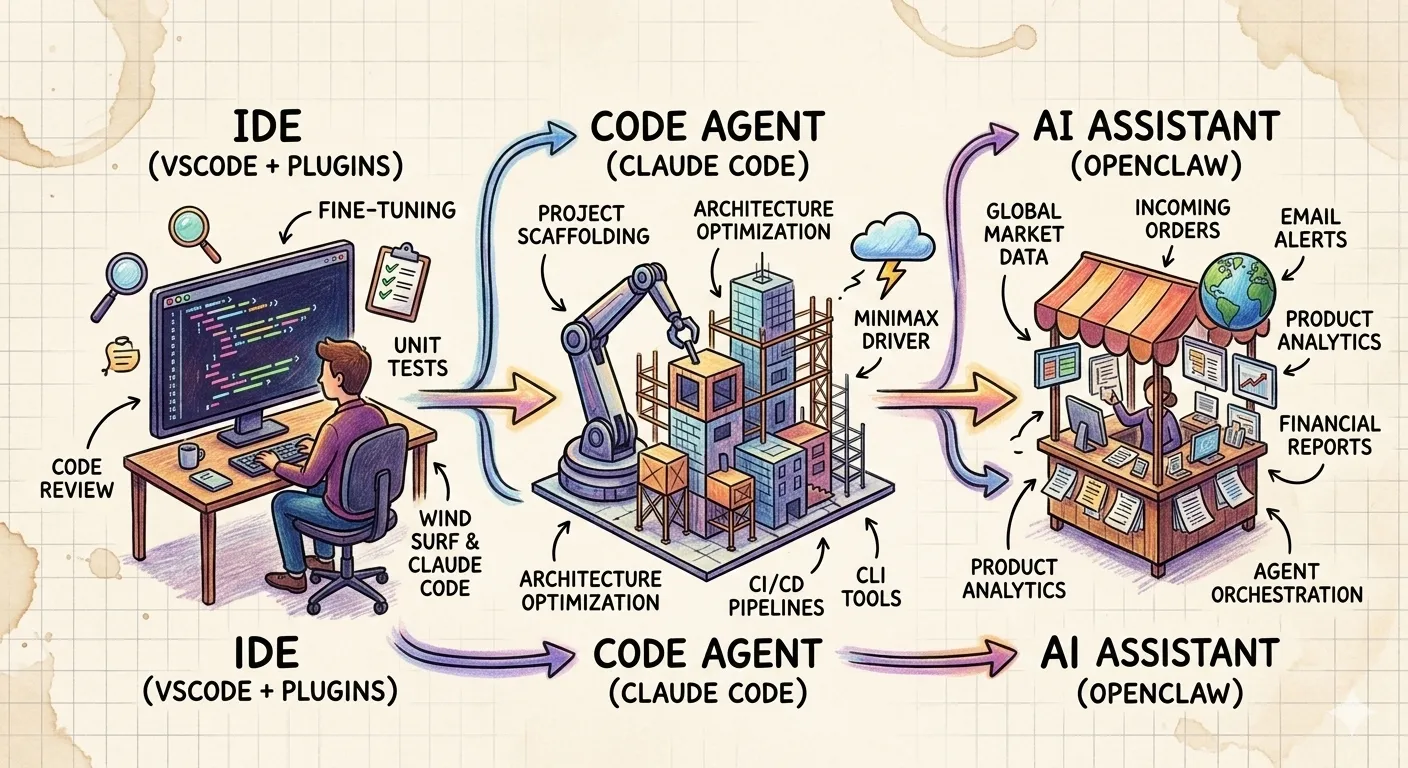
1. IDE: VSCode + Windsurf & Claude Code Plugins
Whether in the era of manual coding or the current AI-driven trend, an IDE remains essential for code review and fine-tuning.
Cursor is currently very popular, offering an excellent integrated experience for autocomplete and chat. If you want a hassle-free, IDE-centric coding experience, Cursor is the top choice.
I chose VSCode not because Cursor’s experience is lacking, but because I also use Claude Code and OpenClaw. I currently subscribe to MiniMax’s monthly Code Planning plan to drive both OpenClaw and Claude Code. Since Cursor’s free tier does not support switching to custom LLMs, paying for Cursor solely for the IDE experience didn’t seem cost-effective for my setup.
VSCode offers superior extensibility. The Windsurf plugin provides smooth code completion, and the Claude Code plugin handles coding assistance. While the integration isn’t as seamless as Cursor’s, it serves as a perfectly capable “drop-in” replacement for daily tasks.
2. Code Agent: Claude Code
I chose Claude Code primarily for its popularity—popularity implies higher industry recognition and a more mature ecosystem. While open-source alternatives like OpenCode offer similar features with more freedom and transparency, stability, reliability, and ease of troubleshooting are higher priorities for a production workflow.
Claude Code’s main drawbacks are its high cost and the risk of account bans in certain regions. However, it supports custom model endpoints (like MiniMax). Although there might be a slight dip in output quality compared to native Claude 3.5, it significantly reduces costs and eliminates the ban risk, making it a worthwhile compromise.
Furthermore, tools like Claude Code that offer CLI and diverse integration methods provide better coverage and extensibility than those strictly bound to an IDE.
3. Assistant: OpenClaw
OpenClaw and Claude Code have overlapping features; both can handle project development and GitHub operations. But in a professional workflow, it’s not just about “completion”—it’s about delivery quality.
Based on current experience, I prefer to let Claude Code handle the heavy lifting of coding—it is more professional, pure, and its ecosystem is more focused. I position OpenClaw as a General-Purpose Work Assistant.
The “OPC” (One-Person Company) model is gaining traction. For an individual, capital and manpower are significant bottlenecks compared to traditional companies. AI can fill these gaps. The value of technologies like OpenClaw lies not in “collaborative coding,” but in handling the non-coding tasks required to make a business model viable.
Suitable scenarios include: tracking market and tech trends, filtering incoming leads/orders, monitoring emails, and analyzing product or financial data.
I am still in the early stages of exploring OpenClaw, and the debugging cost is currently high, but its potential to optimize or even fully automate non-development business tasks is immense.
4. Summary
In short, the next paradigm in software development is about leveraging AI to its fullest. We’re moving from ‘IDE-first’ manual coding to an ‘Agent-centric’ model. Here, the Code Agent takes center stage, the IDE provides auxiliary support, and AI Assistants manage the broader ecosystem—handling everything from funding and product to user operations.