Next.js is currently a very popular Node.js Web framework on the market. After going through Codevolution’s tutorial, my feeling is: its popularity is well-deserved. Next.js is a Web framework that is exceptionally well-suited for frontend developers. An excellent technical solution not only significantly boosts productivity—allowing you to do more with less—but its sound architecture and programming paradigm also help us establish a more accurate and concise cognitive understanding of relevant scenarios.
I. Starting with Web Applications and URLs
Generally speaking, a Web Application refers to software that runs based on an internet browser. It consists of one or more pages, uses URLs to address and access page resources, and links pages together through hyperlinks to form a complete product logic.
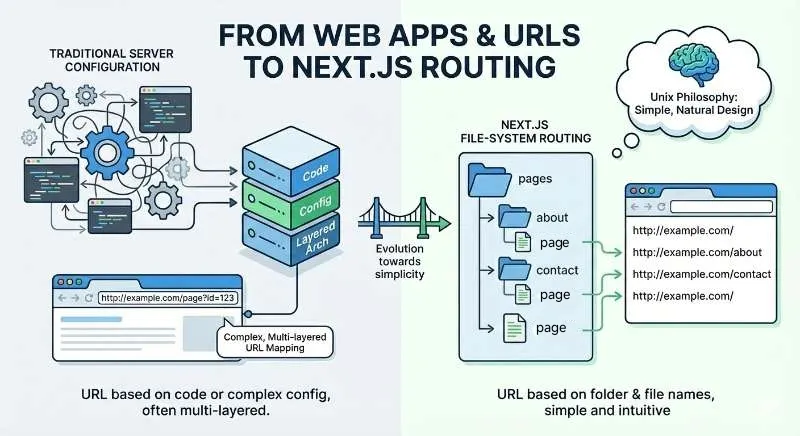
Therefore, implementing the definition and access of page URLs is the foundation of Web products. However, in reality, the URLs of many traditional Web servers are implemented based on code or configuration, sometimes even requiring multi-layer configuration due to layered architecture needs. In contrast, Next.js’s file-system-based routing design appears simple and intuitive when implementing the same functionality. This reminds me of the design of the Unix file system—good design is often simple, natural, and stands the test of time.
Next is the parsing and consumption after resource addressing is completed. Resources are essentially information; information can be consumed from an API, or presented as a page with a specific template. Next.js is very clear in this aspect of design as well: it completes the parsing of resource types and the declaration of various states solely through folders and a limited set of filenames.
In other words, Next.js can build a static site with complete URL definitions based solely on folders and filenames.
II. Common Problems in Traditional Frontend Development
Next, let’s focus on page presentation and rendering. The evolution of frontend technology has followed a rather winding path; while continuously enhancing various capabilities, it has also constantly introduced new problems.
Skipping the earlier eras of jQuery, CMD, and MVC, let’s start directly from the rise of React.
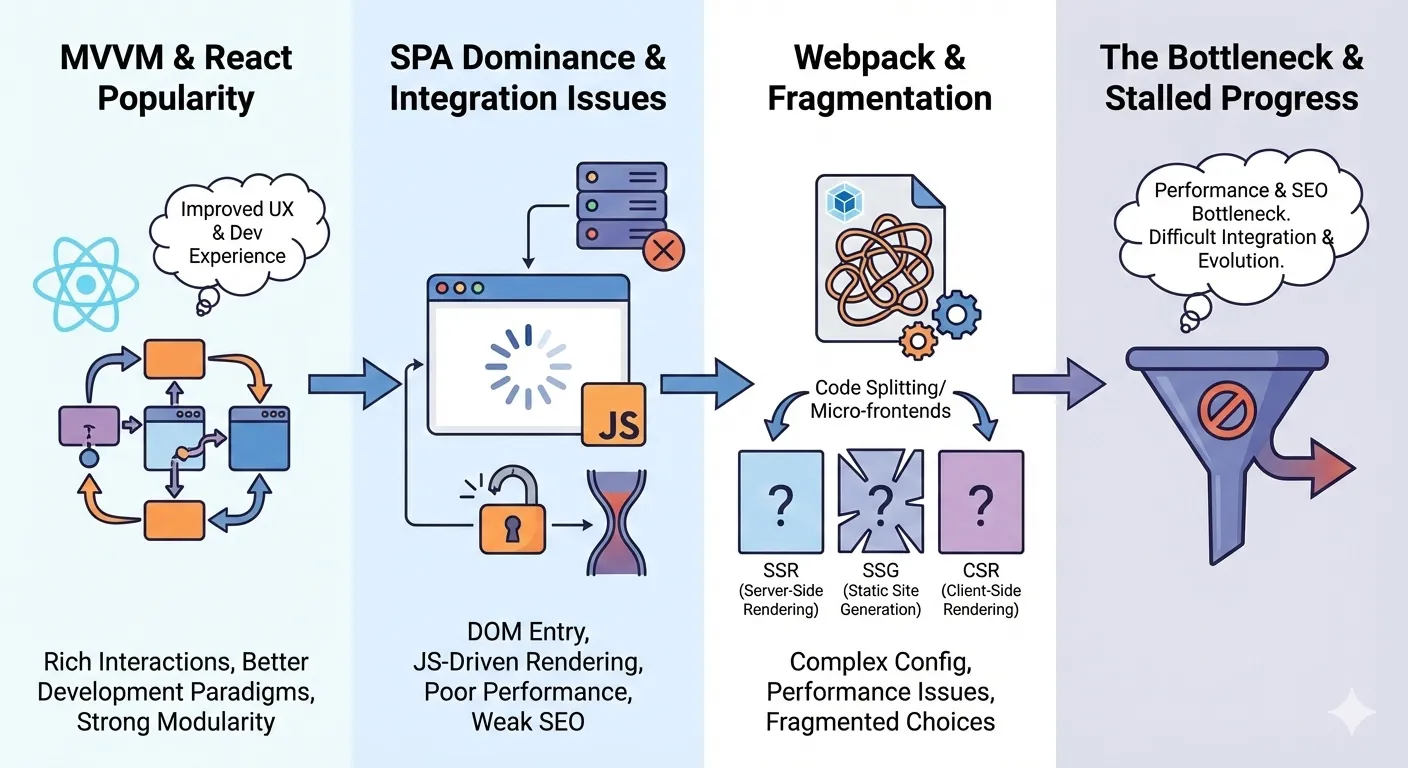
As Web applications became increasingly rich in interaction, MVVM solutions like React began to gain popularity. This was not only because its declarative, rather than imperative, development paradigm was better suited for organizing and expressing rich interactions, but also because its component-based nature offered a more complete modularization strategy, which in turn provided the ability to decompose and reassemble complex scenarios.
At the same time, however, React faced many integration issues. Most common Web frameworks on the market were primarily designed from a backend perspective and offered limited support for frontend view rendering; few frameworks could fully support React’s server-side rendering capabilities. This led to the widespread popularity of Single Page Application (SPA) architectures, where the page DOM serves as the entry point and JavaScript handles the entire rendering process. While these applications are well-equipped to handle rich interactions, they often face poor performance and SEO. To optimize performance, developers had to resort to local code-splitting and fine-tuning, or utilize micro-frontend solutions for decoupling. To improve SEO, some even adopted “spider-user separation” schemes to increase indexing. Meanwhile, the popular Webpack bundling solution of that era, while supporting various frontend build capabilities, also suffered from complex configurations and performance issues. These problems persisted for a long time, and it seemed that SPA performance and SEO had both hit a bottleneck.
Furthermore, page rendering patterns existed in multiple modes, such as Server-Side Rendering (SSR), Static Site Generation (SSG), and Client-Side Rendering (CSR), making frontend development and technology selection highly fragmented. Once the general direction was set, it became extremely difficult to change or integrate different capabilities at a later stage.
III. Next.js Innovations in Programming Paradigm and Architecture
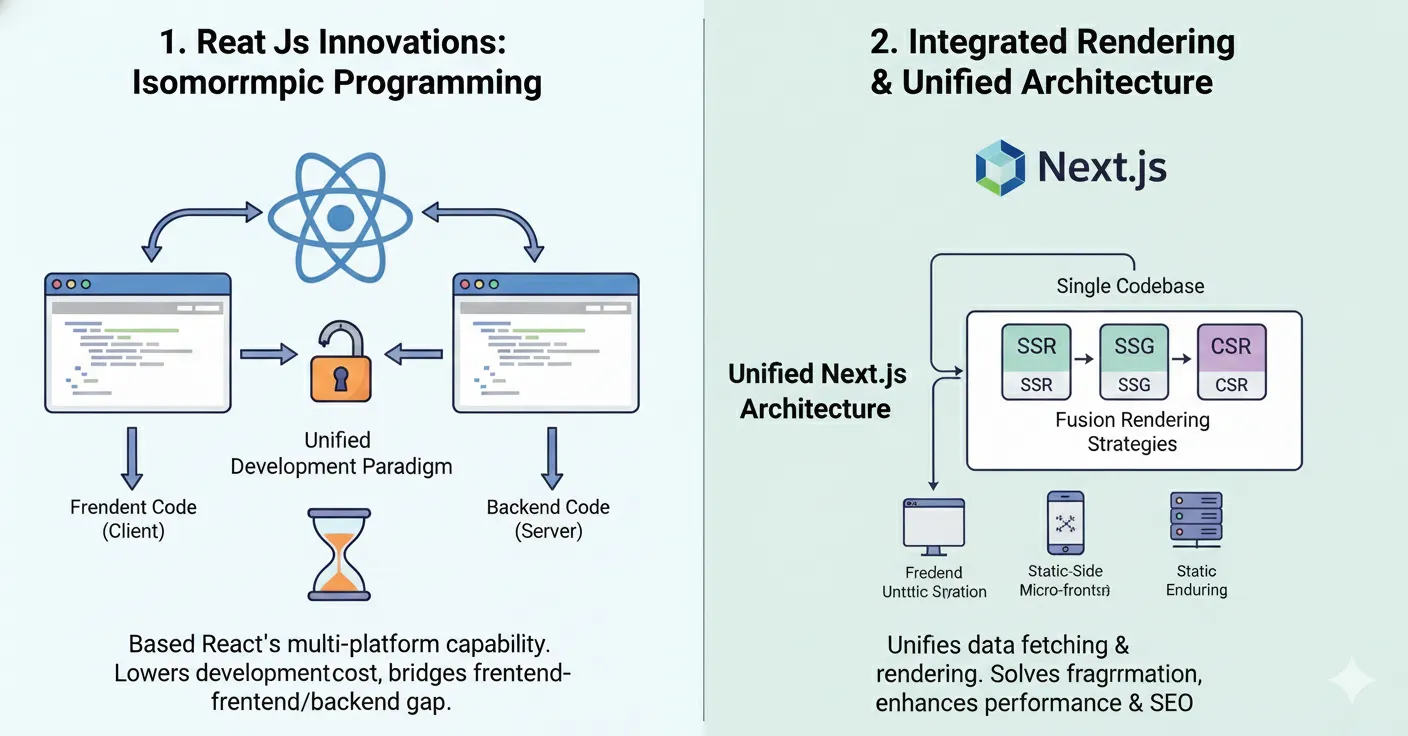
Next.js’s innovation lies mainly in two points: the Isomorphic Programming Paradigm based on React, and a Unified Architecture that integrates rendering strategies.
React’s design surpassed other libraries of its time because it did not rely on browser APIs, enabling support for multi-end rendering, including the server side. React’s popularity in the frontend has already proven its acceptance in the current trend of rich applications. The Next.js isomorphic programming paradigm, based on React, primarily minimizes the programming gap between frontend and backend, thereby reducing production costs.
But actually, the benefit of the React isomorphic paradigm isn’t just about reducing frontend-backend differences and programming costs; its truly exciting power lies in the unified capabilities it brings.
IV. How Next.js Solves Traditional Frontend Problems
Looking back now, traditional frontend development suffered from numerous libraries, large gaps between frontend and backend, difficulties in selecting rendering strategies, and widespread performance and SEO issues in rich interactive applications. Next.js, based on innovations in programming paradigm and architecture, solves these problems from a native level, making everything simple again.
First, the selection dilemma based on rendering strategies has disappeared. You can achieve excellent page-level Server-Side Rendering (SSR), Static Site Generation (SSG), and Client-Side Rendering (CSR) using only Next.js. This not only reduces technical differences caused by selection but also gives applications better capability for later changes and expansion.
Second, SPA performance issues have also disappeared. Hybrid rendering based on RSC (React Server Components) combined with the server is outstanding. It can achieve rapid presentation of the overall page based on server-side rendering and progressively output local content via streaming. As far as I know, this effect is very good, offering better performance than similar micro-frontend schemes of the same period, while having almost none of the technical complexity of the latter. In other words, Next.js solves performance issues from a native angle, and the programming paradigm adds almost no burden.
At this point, you will find that from a frontend perspective, Next.js has almost solved the problems that traditional frontend found hard to break through due to architectural limitations. It possesses the good paradigm of React for rich interactive applications, natively solves the negative issues of engineering and performance from an architectural standpoint, and possesses better extensibility and tension. It forms a very comprehensive capability, turning frontend technology and frontend-backend technology from a fragmented state into a simple, unified whole.
V. New Capabilities Next.js Brings Compared to Traditional Solutions
1. Deep Integration Capabilities with Backend Solutions
Taking Clerk login as an example, by simply configuring the SDK, you can not only seamlessly integrate login and permission management functions for APIs and middleware but also integrate related buttons and forms at the page component level. This drastically reduces the cost of secondary development or self-research that was required in the past.

2. Other New Features
Moreover, Next.js has some creative programming paradigms. For instance, frontend-backend data interaction implemented via useActionState allows the frontend and backend to no longer rely on tedious URL API implementation and parsing. Although it saves a lot of boilerplate code in small scenarios, and still awaits practical verification in finer-grained and larger-scale scenarios, it is indeed refreshing.
VI. Deployment Experience: Engineering Assurance from the Vercel Ecosystem
Next.js is developed by the Vercel team, and Vercel sponsors core open-source projects like React, ensuring close technical cooperation. The build process also adopts high-performance solutions, which work out of the box. Regarding deployment and hosting, using Vercel allows for one-click repository deployment and provides capabilities like runtime CDN acceleration, making the process from development to release seamless for simple products.
Summary: Harvests from Learning Next.js
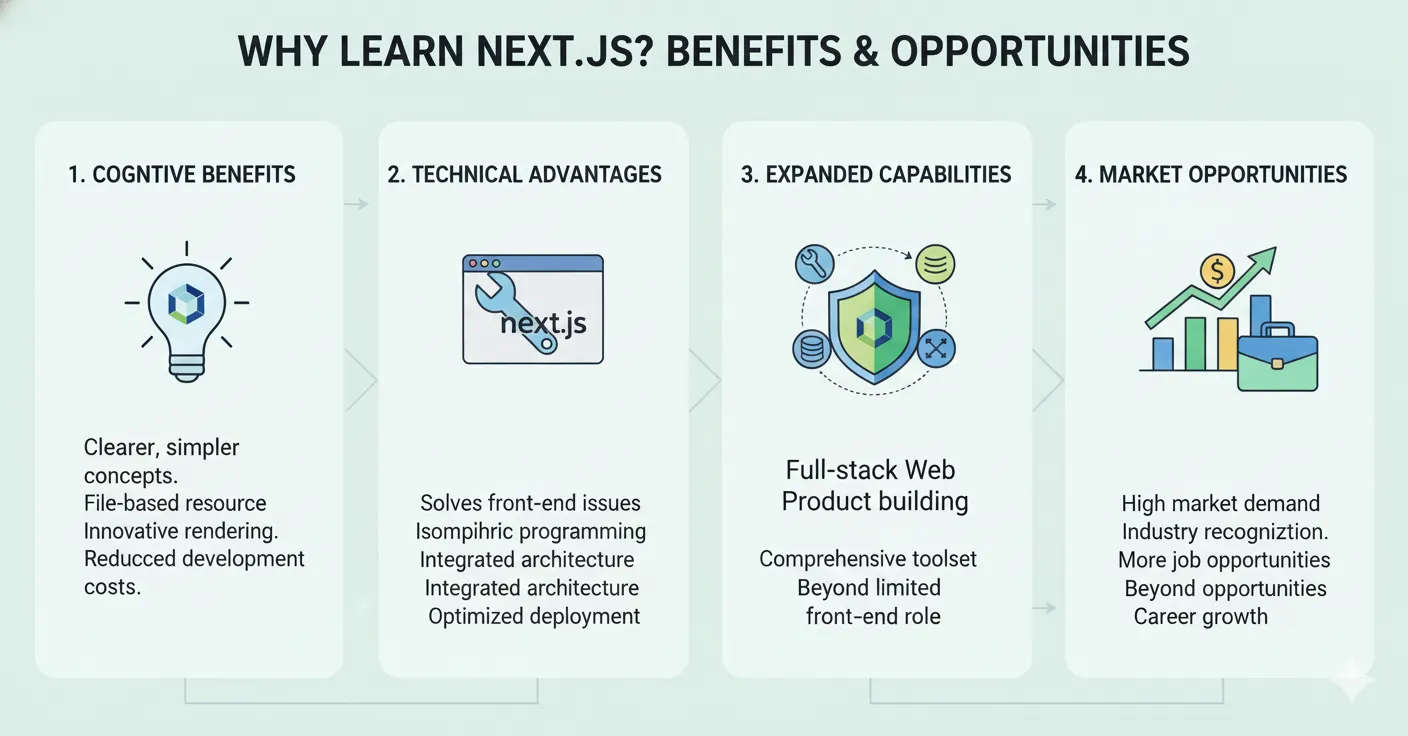
Therefore, Next.js is a Web framework that is particularly suitable for frontend learning. Learning it will bring many rewards:
-
Cognitive Perspective: Resource localization based on files, along with rendering capabilities based on paradigm and architectural innovations, brings a clearer and more concise understanding of scenario concepts, reducing development costs associated with traditional R&D.
-
Technical Perspective: Benefiting from innovations in its isomorphic programming paradigm and unified architecture, Next.js natively solves many problems of traditional frontend development and also optimizes deployment methods.
-
Capability Perspective: The capabilities of a single frontend role are often limited, but Next.js can provide the relatively complete capabilities needed to build Web products.
-
Market Perspective: Next.js has high recognition in the market, which can lead to more job opportunities.